
The lights inside the packed theater had barely dimmed when the whispers began.
At first, they sounded like the ordinary murmur of restless moviegoers shifting in their seats.
Then the murmurs grew louder, sharper, almost frantic.
By the time the credits rolled, audience members were allegedly shouting two words into the darkness: “Epstein Island.”For actor Jim Caviezel, it was not just a reaction to a movie.
It was, in his view, the beginning of something far larger — a public awakening fueled by distrust, fear, conspiracy, and a growing belief among millions of Americans that the world’s most powerful elites have escaped scrutiny for far too long.
That belief has now collided headfirst with one of the most recognizable women on the planet: Oprah Winfrey.
In recent months, viral videos, podcasts, livestreams, and social media threads have exploded with claims attempting to link Oprah to disgraced financier Jeffrey Epstein, convicted producer Harvey Weinstein, Brazilian spiritual healer John of God, and even embattled music mogul Sean Combs.
The accusations are dramatic, emotionally charged, and often presented as evidence of a hidden network of celebrity protection and corruption operating behind the polished façade of Hollywood philanthropy.
But beneath the cinematic language and apocalyptic warnings lies a far more complicated reality — one where documented facts, public associations, speculation, and internet-fueled paranoia are increasingly becoming tangled together in ways that are reshaping American discourse itself.
The frenzy reignited after renewed attention surrounding “Sound of Freedom,” the controversial child-trafficking thriller distributed by [Angel Studios](https://www.angel.com?utm_source=chatgpt.com).
The film, loosely inspired by anti-trafficking activist Tim Ballard, became a cultural flashpoint almost overnight.
Supporters hailed it as a brave exposé about child exploitation that Hollywood allegedly tried to bury.
Critics accused its promoters of amplifying conspiracy-adjacent narratives tied to QAnon-style rhetoric.
At the center of the storm stood Caviezel, whose interviews promoting the movie quickly escalated beyond discussions of filmmaking and into sweeping claims about global trafficking networks, corrupt elites, and hidden systems of power.
During appearances on conservative podcasts and political stages, the actor repeatedly referenced what he described as an “eight-armed octopus” of organized exploitation stretching into institutions, media, and government.
“The media has lied too many times,” Caviezel said during one appearance, arguing that Americans were finally beginning to question official narratives.
Those comments landed in an already volatile political climate where distrust in institutions has become deeply entrenched.
The Epstein scandal — which revealed disturbing connections between wealthy businessmen, celebrities, royalty, and politicians — left a permanent scar on public confidence.
Every newly released court document, every leaked flight log, and every resurfaced photograph has fueled a national obsession with uncovering who knew what, and when.
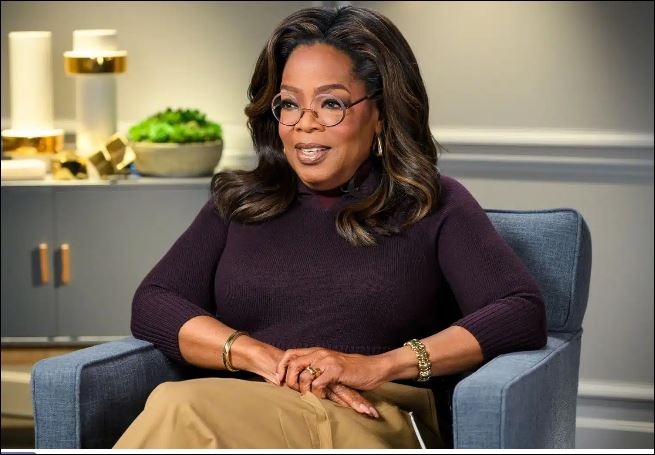
Into that environment stepped Oprah, perhaps uniquely vulnerable to this kind of scrutiny because of her decades-long image as America’s moral compass.
For generations, she cultivated a brand built on empathy, healing, confession, and redemption.
She introduced unknown authors to millions of readers, elevated self-help gurus into household names, and sat across from survivors of trauma in some of the most emotional interviews in television history.
But the same immense cultural power that made Oprah beloved has now made her a target.
Online commentators have zeroed in on her past friendships and public associations with disgraced figures.
Photos of Oprah with Weinstein at Hollywood events have circulated endlessly across social media.
Old interviews with John of God — whom Oprah once featured on her platform before his conviction on sexual abuse charges — have resurfaced with accusatory captions.
Her attendance at celebrity gatherings involving figures now under scrutiny has become fodder for viral TikToks and YouTube monologues claiming to reveal a hidden pattern.
None of this proves criminal wrongdoing by Oprah herself.
To date, no evidence has emerged publicly showing that Oprah participated in or facilitated criminal conduct connected to Epstein or trafficking operations.
Yet in the age of viral suspicion, proximity alone has become enough to ignite public outrage.
Part of the firestorm stems from confusion surrounding Epstein-related court records.
Oprah’s name has reportedly appeared in discussions and online summaries of released materials, but being named in documents or associated socially with individuals connected to Epstein is not, by itself, evidence of criminal behavior.
Legal analysts have repeatedly warned that many names appearing in Epstein-related files include acquaintances, public figures, staff, or people mentioned only in passing.
Still, for millions watching from the outside, nuance has become almost impossible to separate from emotion.
The internet no longer operates like a courtroom.
It operates like a pressure cooker.
Every image becomes a clue.
Every silence becomes suspicious.
Every friendship becomes potential evidence.
And Oprah’s silence — or at least her refusal to publicly engage with every allegation circulating online — has only intensified speculation among critics who argue that powerful figures are shielded from accountability.
One of the most emotionally charged chapters repeatedly cited involves the Oprah Winfrey Leadership Academy for Girls in South Africa.
Opened in 2007 as a flagship philanthropic project, the school was intended to provide educational opportunities to disadvantaged girls.
Soon after opening, however, a dormitory employee faced accusations involving misconduct against students.
Oprah publicly expressed outrage and said she was “deeply saddened” by the allegations.
The accused staff member was later acquitted after contradictions emerged in testimony.
Yet the incident never fully disappeared from public consciousness.
Online rumors grew over the years, expanding far beyond verified facts into increasingly extreme territory, including unsupported claims about disappearances and secret cover-ups.
No evidence has substantiated those sensational accusations, but they continue circulating widely across conspiracy forums and video platforMs.
That is the modern reality of internet-era scandal: once suspicion attaches itself to a public figure, it rarely leaves.
The Weinstein connection has proven equally explosive.
Before his downfall, Weinstein was one of Hollywood’s most influential producers, regularly photographed alongside A-list celebrities, politicians, journalists, and media executives.
Oprah, like countless others in the entertainment world, attended events where Weinstein was present and publicly interacted with him over the years.
After Weinstein’s conviction, critics began revisiting those relationships with harsher scrutiny.
Some argued that powerful people in Hollywood either ignored warning signs or benefited from a culture of silence surrounding abuse allegations.
Actress Kadian Noble later spoke publicly about how Weinstein’s connections to respected celebrities made him appear trustworthy.
“If Oprah’s with him, why should I worry?”
Noble recalled thinking during one interview, describing the psychological effect of seeing Weinstein embraced by admired public figures.
That quote has since been weaponized online as evidence that celebrity proximity can provide social cover for predators — a broader cultural critique that extends far beyond Oprah herself.
Meanwhile, supporters of Oprah argue that much of the backlash relies heavily on guilt by association and retrospective judgment.
They point out that many public figures maintained relationships with individuals later exposed for misconduct, often before allegations became widely known.
They also note that Oprah herself has spoken extensively about surviving childhood sexual abuse and has dedicated large portions of her career to discussing trauma, victimization, and healing.
But emotional logic rarely satisfies internet outrage.
The result is a combustible mix of celebrity culture, political distrust, anti-elite anger, and algorithm-driven sensationalism.
Videos accusing Oprah of everything from protecting predators to participating in shadowy global networks routinely rack up millions of views.
The more shocking the allegation, the faster it spreads.
For ordinary Americans already struggling with economic anxiety, political division, and collapsing trust in institutions, these stories tap into something primal: the fear that the powerful live by different rules.
That fear has become fertile ground for personalities like Caviezel, who frame themselves not merely as actors or activists, but as whistleblowers fighting a hidden war.
In speeches and interviews, Caviezel has warned of a coming reckoning — a dramatic moment when hidden corruption will allegedly be exposed.
Whether viewed as courageous truth-telling or dangerous conspiracy rhetoric, the message resonates with audiences who feel abandoned by traditional media.
And that may be the most significant part of this entire saga.
Because this story is no longer just about Oprah.
It is about the collapse of public trust itself.
The old gatekeepers — television networks, newspapers, Hollywood studios — no longer control the narrative the way they once did.
Now, anyone with a microphone, editing software, and a viral thumbnail can shape national conversations overnight.
Allegations spread faster than investigations.
Suspicion spreads faster than evidence.
Emotion spreads faster than fact.
For celebrities, that means reputations can be destroyed in days.
For audiences, it means living in an information environment where truth feels increasingly impossible to pin down.
And for America, it signals something even deeper: a nation locked in a permanent battle over who deserves to be believed.
As Epstein’s shadow continues hanging over politics, entertainment, and media, nearly every major public figure who ever crossed paths with powerful elites risks being pulled into the vortex.
Some connections may reveal legitimate questions worth examining.
Others may spiral into baseless paranoia amplified by outrage algorithms hungry for engagement.
But the appetite for answers is not going away.
Not after Epstein.
Not after Weinstein.
Not after years of institutional scandals that shattered public confidence across industries.
Somewhere between legitimate accountability and conspiracy-fueled hysteria lies the uncomfortable reality Americans are now struggling to navigate.
And in that unstable terrain, even icons once considered untouchable can suddenly find themselves standing at the center of a digital mob armed with screenshots, old photographs, and unanswered questions.