
The war inside Hollywood has always been whispered about in private — behind locked studio gates, inside black SUVs with tinted windows, at afterparties where billionaires and celebrities mingle while assistants stand guard outside the doors.

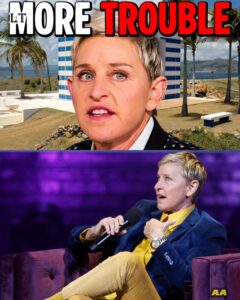
But now the whispers are getting louder, uglier, and far more public after comedian and television icon Roseanne Barr reignited one of the most explosive conspiracy-laced feuds in modern entertainment history, openly accusing Ellen DeGeneres of being tied to the same elite protection culture that shielded disgraced financier Jeffrey Epstein for years.
What started as another provocative podcast appearance quickly spiraled into a firestorm spreading across YouTube, TikTok, Facebook, and fringe political media, where clips of Roseanne’s comments exploded into millions of views within hours.
In those appearances, the former sitcom queen painted Hollywood not as a glamorous dream factory, but as a ruthless machine fueled by manipulation, blackmail, image management, and silent obedience.
And according to Roseanne, the difference between surviving in that machine and being destroyed by it comes down to one thing: whether you protect the system or threaten it.
For many Americans, the accusations sound insane at first glance — the kind of sprawling celebrity conspiracy theory usually buried deep in internet forums at three in the morning.
But the reason the story refuses to die is because it feeds into something already festering in public consciousness: the growing belief that powerful people operate under a completely different set of rules than everyone else.
Roseanne knows exactly how to weaponize that anger.
Sitting in interviews with conservative commentators and independent podcasters, she describes herself not as a canceled celebrity bitter about losing her career, but as a casualty of an entertainment industry terrified of anyone who refuses to stay quiet.
She claims her infamous 2018 firing from ABC was never truly about the racist tweet that detonated her career overnight.
In her version of events, that moment became the perfect excuse for executives and media insiders to erase a woman they already considered dangerous.
“They were sending a message,” Roseanne said in one appearance, her voice shifting between exhaustion and fury.
“If you step out of line, they destroy you publicly.”
The contrast she draws between herself and Ellen is central to the entire narrative.
Roseanne portrays herself as the rebellious outsider who refused to play Hollywood’s political and social game, while Ellen became the polished, smiling face of the industry establishment — dancing on daytime television, joking with movie stars, handing gifts to audience members, and building an empire around the phrase “be kind.”
To Roseanne’s supporters, that contrast now looks suspicious in hindsight.
Because while Roseanne’s career imploded in spectacular fashion after one social media post, Ellen survived decades in the center of elite Hollywood circles despite years of rumors about toxic workplace behavior, celebrity favoritism, and internal fear among staffers on her daytime show.
When allegations finally surfaced publicly in 2020 describing a hostile work environment behind the scenes of “The Ellen DeGeneres Show,” many viewers felt blindsided.
The cheerful television persona suddenly cracked open.
Former employees described intimidation, humiliation, and fear.
WarnerMedia launched an internal investigation.
Producers were fired.
Ellen later apologized publicly on air, acknowledging that problems existed inside the workplace she controlled.
But even then, critics noticed something unusual: despite enormous backlash, Ellen largely escaped the kind of total professional annihilation that hit figures like Roseanne almost instantly.
That disparity became fuel for a growing online belief that Hollywood protects certain people while sacrificing others.
And then there is Epstein — the ghost haunting every conversation about elite power in America.
Even years after his death inside a Manhattan jail cell in 2019, Epstein’s network remains one of the most radioactive scandals in modern history.
Flight logs, celebrity associations, political connections, billionaire friendships, private island visits — the sheer scope of the scandal permanently damaged public trust in institutions that once seemed untouchable.
That distrust created fertile ground for theories like Roseanne’s to spread at lightning speed.
In recent interviews, Roseanne repeatedly referenced investigative writer Nick Bryant, who spent years digging into Epstein’s infamous “little black book” and exposing connections between wealthy elites and the convicted sex offender.
Bryant has publicly argued that Epstein’s operation was far larger and more protected than authorities initially admitted.
Those claims, mixed with Roseanne’s fury toward Hollywood insiders, created a combustible narrative that online audiences immediately latched onto.
Inside that narrative, Ellen becomes more than a former talk show host.
She becomes symbolic of an entire celebrity ecosystem accused of protecting itself at all costs.
There is, however, a major distinction often lost as the story spreads online: Roseanne has offered no verified evidence linking Ellen to criminal conduct involving Epstein.
Much of what circulates through podcasts and viral clips is speculation layered on top of speculation, stitched together through association, timing, and distrust rather than concrete proof.
But in the current media climate, emotional narratives often travel faster than facts.
And emotionally, this story hits every nerve in America at once.
Celebrity hypocrisy.
Media manipulation.
Elite privilege.
Censorship.
Political tribalism.
Distrust of institutions.
The fear that ordinary people are constantly lied to while the rich protect one another behind closed doors.
That’s why the controversy has exploded far beyond entertainment gossip.
In conservative circles, Roseanne has increasingly been reframed as a whistleblower figure — a celebrity exile who supposedly saw the industry’s dark side firsthand and paid the price for speaking too openly.
Clips of her interviews are edited with ominous music, rapid-fire Epstein headlines, paparazzi footage, and images of Hollywood mansions flashing across the screen like scenes from a political thriller.
Meanwhile, Ellen has largely remained silent.
The former daytime giant stepped away from her talk show in 2022 after nearly two decades on air, later joking in stand-up routines that she had been “kicked out of show business for being mean.”

The line generated laughs from audiences, but online critics immediately twisted it into something darker, arguing that the “mean boss” narrative was itself a carefully managed distraction hiding larger truths.
There is no evidence supporting those theories.
But the absence of evidence has done little to stop the machine.
Because the machine now runs on suspicion itself.
Hollywood has spent years battling public perception problems after the collapse of once-untouchable figures like Harvey Weinstein, whose conviction transformed the entertainment industry forever.
The #MeToo era exposed how power could shield abuse for decades while victims stayed silent out of fear.
That history makes Americans more willing than ever to believe hidden systems of protection exist behind fame and wealth.
Roseanne understands that psychology perfectly.
Again and again, she frames Hollywood not as an artistic industry but as a hierarchy enforced through intimidation and loyalty.
In one interview, she described entertainment executives as people who “protect their assets.”
In another, she suggested major scandals are strategically managed to preserve the broader structure of power itself.
Those claims become even more potent because Roseanne herself once stood at the absolute center of American television culture.
When “Roseanne” premiered in 1988, it shattered television norms by portraying working-class America in raw, messy, painfully realistic ways rarely seen on network TV at the time.
The Conner family struggled financially, fought constantly, and looked nothing like the polished sitcom families dominating prime time.
Roseanne Barr became both a cultural icon and a constant source of controversy because she refused to behave like a traditional Hollywood star.
That rebellious image still defines her today.
Even after being effectively blacklisted from mainstream television following the Valerie Jarrett tweet controversy, Roseanne never disappeared completely.
Instead, she migrated into alternative media ecosystems where distrust of corporate news and Hollywood elites already runs deep.
There, her transformation from disgraced actress to anti-establishment crusader found a massive audience waiting for someone to validate their suspicions.
And now, every time Epstein’s name resurfaces in headlines, Roseanne’s accusations regain momentum.
The broader danger, experts warn, is that the line between legitimate institutional criticism and sprawling conspiracy thinking continues to erode online.
Real scandals involving abuse, corruption, and media hypocrisy become mixed together with unverified accusations, occult symbolism, secret societies, and apocalyptic political narratives until audiences struggle to separate reality from performance.
But in America right now, performance often feels more emotionally convincing than reality.
Especially when public trust has already collapsed.
Poll after poll shows Americans increasingly distrust media companies, government agencies, celebrity culture, and major institutions across the board.
Into that vacuum steps a story like Roseanne versus Ellen — not simply as celebrity drama, but as symbolic warfare between two visions of America itself.
One side sees Roseanne as unstable, conspiratorial, and reckless, a celebrity unable to accept responsibility for her own downfall.
The other sees her as proof that powerful industries destroy anyone who refuses to conform.
And somewhere between those extremes lies the uncomfortable truth that keeps audiences endlessly clicking.
Because whether Roseanne’s claims are credible or not, millions of people are clearly ready to believe them.
That may be the most explosive part of this entire saga.
Not the podcasts.
Not the accusations.
Not even Epstein.
But the fact that an enormous portion of the public now instinctively assumes the worst about the people who dominate American culture.
Hollywood once sold fantasy for a living.