
From “Be Kind” to Dark Rumors: Unpacking the Explosive Claims Linking Ellen DeGeneres to Epstein Files
In the swirling vortex of Jeffrey Epstein’s released documents, few names have generated as much online frenzy as Ellen DeGeneres.
Once the undisputed queen of daytime television, the comedian known for her “Be Kind” mantra now finds herself at the center of persistent conspiracy theories that paint a far darker picture.
A newly circulated voicemail, coded emails, tragic deaths, and a sudden permanent move to England have combined to create one of the most explosive celebrity scandals in recent memory.The latest spark came from a voicemail recovered from Epstein’s office line. In it, a voice appears to reference a victim attempting to expose connections involving a high-profile Hollywood figure.
Online investigators quickly linked the timing and context to Anne Heche, Ellen’s ex-girlfriend from the late 1990s.
Heche died in August 2022 following a fiery car crash in Los Angeles. Her death was ruled an accident resulting from smoke inhalation and thermal injuries, but conspiracy communities pointed to inconsistencies in footage and reports, suggesting foul play tied to Epstein knowledge.
Ellen’s show ended in May 2022 amid workplace toxicity allegations. Months later, both Heche and Stephen “tWitch” Boss — Ellen’s beloved co-host and executive producer — were gone.
TWitch died by suicide in December 2022, leaving a note that reportedly referenced personal struggles, including burdens from his time on the show.
The clustering of these losses fueled speculation that anyone getting too close to certain truths was being silenced.
DeGeneres’ name does appear in the massive Epstein file releases. Fact-checkers confirm hundreds of mentions, but they are largely peripheral: news articles about other celebrities forwarded to Epstein, compilations of her old tweets, an Apple News digest, and one email from publicist Peggy Siegal describing seeing DeGeneres dancing at a St.
Barts party. There are no flight logs, no victim statements directly accusing her of wrongdoing, and no evidence supporting claims of criminal involvement.
Yet the internet has connected dots aggressively. Viral posts claim Ellen appears over 1,100 times.
Analysts highlight coded language in Epstein’s emails — terms like “pizza,” “Beef jerky,” “Grape soda,” and other food references used in strange contexts.
Some researchers and commentators suggest these were code for illicit activities, including possible human trafficking elements or even more disturbing rituals involving stem cells and consumption.
Epstein’s documented interest in genetic research and longevity treatments added fuel to theories about elite harvesting practices.
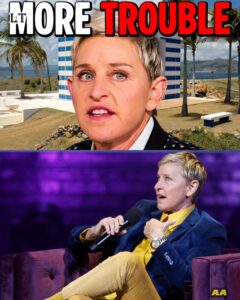
One of the most visually striking claims involves the set of The Ellen DeGeneres Show.
The blue-and-white striped temple on Epstein’s Little St. James island bears an uncanny resemblance to elements of Ellen’s stage design — columns, cheerful aesthetic, palm trees in the background.
While dismissed by many as coincidence or shared design trends, the parallel became meme fodder and proof for those convinced Hollywood was flaunting secrets in plain sight.
Ellen’s relocation only intensified the scrutiny. In late 2024, she and wife Portia de Rossi moved to a farmhouse in the Cotswolds.
By July 2025, Ellen confirmed the move was permanent, citing Donald Trump’s election victory. “We woke up to crying emojis… everything here is just better,” she told a live audience.
Critics noted the timing aligned with waves of Epstein file releases and heightened online discussions.
She sold her Montecito mansion and appeared to step away from American public life entirely.
The most extreme allegations — that Ellen was involved in cannibalism or consumed parts of Anne Heche — have been thoroughly debunked by fact-checkers including Snopes.
References to cannibalism and DeGeneres exist separately in the files, with no connection. Claims of her being “Hollywood’s most prolific cannibal” originated in fringe social media posts and spread rapidly despite lacking any supporting evidence in the documents.
Still, the broader context of Epstein’s network keeps the conversation alive. Victim diaries and statements describe horrific grooming, abuse, and coercion involving powerful figures.
Some entries detail pregnancies, loss of children, and unimaginable trauma. Ghislaine Maxwell’s ongoing legal maneuvers, including claims of 25 unnamed co-conspirators with secret settlements, have kept the case from fading.
New Mexico’s independent investigation into Zorro Ranch and upcoming congressional hearings ensure more revelations may come.
Ellen has not directly addressed the Epstein rumors. Her silence, combined with the move abroad, has been interpreted by some as evasion and by others as exhaustion from years of scrutiny — first the workplace allegations that ended her show, then political backlash, and now conspiracy overload.
The saga reveals deeper cultural fault lines. In the age of massive document dumps and algorithmic amplification, peripheral mentions can be twisted into guilt by association.
High-profile names appear in Epstein records for innocuous reasons — media mentions, third-party emails, social overlaps — yet public trust in institutions is so low that many assume cover-ups.
DeGeneres built an empire on kindness and authenticity. The gap between that image and allegations of a toxic workplace already damaged her brand.
The Epstein whispers have pushed the narrative into far more sinister territory. Whether any substantive evidence ever emerges remains uncertain.
For now, the story thrives on unanswered questions: the voicemail, the deaths, the codes, the island temple lookalike, the sudden exit to England.
As more files potentially surface and survivors continue speaking out, the pressure on everyone once connected to Epstein’s orbit only grows.
Ellen DeGeneres, living quietly in rural England, has become an unlikely symbol of Hollywood’s reckoning — loved by millions for years, now watched with suspicion by many more.
The voicemail may never lead to concrete proof. The coded emails may remain open to interpretation.
The deaths may stay tragic coincidences in the eyes of authorities. But in the conspiracy-driven corners of the internet, the story has already been written.
Ellen’s fall from grace, whether deserved or manufactured, continues to captivate, horrify, and divide audiences worldwide.
In the end, the Epstein files have done what they always do: expose uncomfortable proximities among the elite while leaving enough ambiguity to let theories flourish.
For Ellen DeGeneres, the “Be Kind” era feels like ancient history. A new, far darker chapter has taken its place — one where facts and fiction battle daily for dominance in the public imagination.